Understanding Your Glasses Prescription
There are many readings that will or may appear on your prescription for glasses. In this section we will describe each. The main ones we are concerned with are sphere, Cylinder (if applicable), Axis (if applicable), Add, Pupillary Distance, and sometimes Prism.
Sphere (SPH)
The sphere specifies the strength of lens required to correct the focus.
A plus + sphere is one to correct long-sightedness problems (hyperopic which is a difficulty focusing on close objects).
A minus- sphere is used to correct short-sightedness (myopia which is a difficulty focusing on distant objects).
It will be a number up to -/+ 8. If you see a symbol like this: 8 do not mistake it as an 8 on it’s side, it’s actually representing infinity (plano).
Cylinder (CYL)
The cylinder value is used to compensate for astigmatism (an astigmatism is where the eye isn’t perfectly spherical causing the eye to have difficultly focusing at certain angles).
It will be a number -/+4. Watch out for some opticians putting the + or - sign above the number and not having the decimal point for example 050, meaning 0.50.
Axis
If you have a Cylinder reading you will also have an Axis reading.
It will be a number between 0 and 180.
Add (Near Addition)
The add is for a reading correction and is used for making reading glasses, or as part of bifocal or varifocal glasses.
Prism
A prism is used to correct a lazy eye.
Other Measurements
There are some other measurements which you might see appear on your prescription but ones that you shouldn’t need to worry about:
6/36 markings = another indicator about how good your vision is, but it is not needed to make your glasses.
DS = Dioptres Shere. This is where there is only sphere power and no cylinder.
Plano (PL) = this is a placeholder for the number zero or infinity.
D.V. = Distance Vision.
N.V. = Near Vision (reading)
Balance = This is used where one eye had little or no vision, but the optician wants to ensure the lenses have similar weights and thicknesses for cosmetic reasons.
Pupilliary Distance (PD)
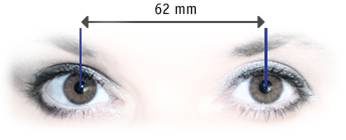
The PD is the distance in millimetres between the centres of your two pupils (the black bits in the middle of your eyes). This only starts to become particularly important on strong prescriptions greater that plus or minus 5.
There are several ways to get your PD. The first and easiest way is just to ask your optician to add it onto your prescription at your eye test.
If you can’t get it at your eye test, or you are not having a new eye test if your last prescription is less than two years old, you can contact the Optometrist that made your last pair of glasses as they will have taken that measurement and should be able to tell you.
Lastly, if you still cannot get the PD measurement, you can measure it yourself at home.
To measure it yourself:
- look into the mirror and hold a ruler to the bridge of your nose with one hand.
- Close one eye and move the ruler across so that the 0 measurement is directly in front of your open eye.
- Open your eye and close the other one.
- Make a note of the measurement directly in front of your open eye.
- Repeat the process several times to ensure you’ve got the correct measurement.
Getting a friend to measure your PD:
- Sit opposite from your friend.
- Your friend can hold a ruler up to your face just above your eyes.
- Whilst looking directly at your face, your friend can measure the distance between the middle of your two pupils.
Measuring at home might not give you a 100% accurate result, but it will give you a result that will be suitable for buying glasses unless you have a very high prescription.
Next onto: Where To Buy From
< Previous Guide Page Next Guide Page >
|